


Oct 16, 2026

Sep 28, 2026

- Share on:


-
 copied
Atrial fibrillation (AFib) is the most commonly treated cardiac arrhythmia in the United States and is frequently encountered in both inpatient and outpatient settings. As CDI professionals, we frequently see AFib documented as an active diagnosis, historical condition, comorbidity, or contributor to other serious conditions such as stroke, heart failure, and thromboembolic disease.
While AFib may appear straightforward, documentation often lacks vital details regarding the type, chronicity, management, and associated complications. Understanding the fundamentals of AFib can help CDI specialists identify query opportunities, validate diagnoses, and ensure the medical record accurately reflects the patient's condition.
Understanding the Pathophysiology of AFib
AFib is an abnormal heart rhythm that originates in the atria, the upper chambers of the heart. Instead of contracting in an organized fashion, the atria fire rapidly and chaotically, resulting in an irregular heartbeat.
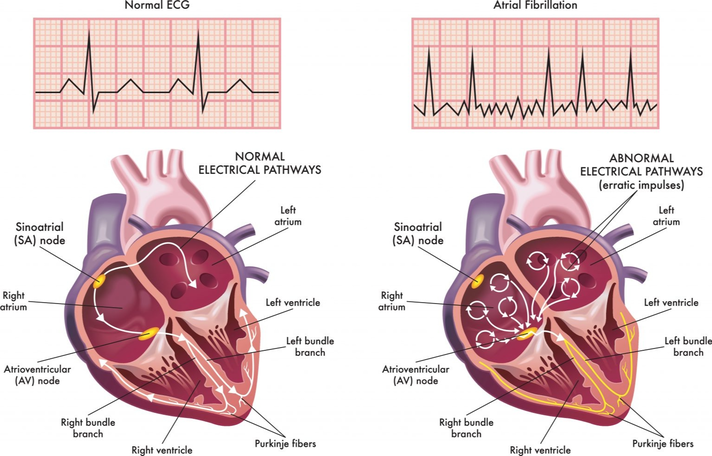
Think of the heart as having its own electrical system. A natural pacemaker, called the sinoatrial (SA) node, sends signals that coordinate each heartbeat. In AFib, these signals become disorganized, causing the atria to “quiver” rather than contract effectively. This can allow blood to pool in the atria, increasing the risk of clot formation and stroke.
Types of Atrial Fibrillation
AFib is classified according to how long the abnormal rhythm persists:
| Type | Definition |
|---|---|
| Paroxysmal AFib | Episodes terminate spontaneously, usually within 7 days |
| Persistent AFib | Lasts longer than 7 days and may require intervention |
| Long-Standing Persistent AFib | Continuous AFib lasting more than 12 months |
| Permanent AFib | Rhythm control attempts are no longer pursued |
CDI Tip: Rapid Ventricular Response (RVR) is not a type of atrial fibrillation, but rather a clinical manifestation. It may occur with any type of AFib when the ventricular rate is rapid, typically >100bpm and does not have a unique ICD-10-CM code.
Common Risk Factors
AFib frequently occurs in patients with underlying cardiovascular and metabolic conditions, including:
- Hypertension
- Heart disease
- Chronic kidney disease
- Obstructive sleep apnea
- Prior cardiac surgery
- Advanced age
- Excessive alcohol use
Recognizing these associated conditions can help CDI specialists better understand the clinical context of the diagnosis.

Treatment
Treatment of atrial fibrillation generally focuses on three primary goals:
- controlling the ventricular rate
- restoring or maintaining normal sinus rhythm when appropriate
- reducing the risk of stroke
Common treatment approaches include:
| Treatment Strategy | Examples |
|---|---|
| Rate Control | Metoprolol, Carvedilol, Cardizem, Digoxin |
| Rhythm Control | Amiodarone, Tikosyn, Flecainide, Cardioversion |
| Anticoagulation | Eliquis, Xarelto, Pradaxa, Warfarin |
CDI Tip: IV Cardizem infusions, IV beta blockers, telemetry monitoring, cardiology consultation, antiarrhythmic therapy, cardioversion, and anticoagulation management may support clarification of AFib type, chronicity, and symptom burden.
Procedures Associated with AFib Management
- Electrical Cardioversion: Restores normal sinus rhythm using a controlled electrical shock.
- Catheter Ablation: Destroys areas of cardiac tissue responsible for abnormal electrical signals and may be used for recurrent or symptomatic AFib.
- Left Atrial Appendage Occlusion: Closes the left atrial appendage to help reduce stroke risk in select patients.
For CDI professionals, treatment plans often provide valuable insight into whether AFib is active, chronic, or requiring escalation of care.
Documentation Considerations
AFib is a rhythm diagnosis and should be supported by clinical evidence, provider assessment, and appropriate management. CDI specialists should review the record for:
- EKG or telemetry evidence of AFib
- Symptoms such as palpitations, dizziness, fatigue, or shortness of breath
- Physical findings such as an irregularly irregular rhythm
- Cardiology consultation and treatment plans
- Anticoagulation, rate-control agents, antiarrhythmics, or cardioversion
Documentation should clearly identify whether AFib is active or historical and, when possible, specify the type of AFib present.
CDI Chart Review Checklist
When AFib appears in the record, consider:
- Is AFib clinically supported?
- Is there EKG confirmation?
- Is AFib active or historical?
- Has the provider documented the type?
- Is RVR present?
- What medications are being administered?
- Is anticoagulation documented?
- Is AFib contributing to another condition?
- Does the documentation accurately reflect treatment?
- Is a query warranted?
Key Takeaways
Atrial fibrillation is the most common cardiac arrhythmia and significantly increases a patient's risk of stroke and other serious complications. Clinical support for an AFib diagnosis may be found through review of EKG findings, telemetry monitoring, provider documentation, and treatment plans. Accurate and complete documentation of AFib is essential to support coding specificity, clinical validation, and appropriate patient care.
References
- Centers for Disease Control and Prevention. (n.d.). About atrial fibrillation. https://www.cdc.gov/heart-disease/about/atrial-fibrillation.html
- American Heart Association. (n.d.). Atrial fibrillation. https://www.heart.org/en/health-topics/atrial-fibrillation
- Joglar, J. A., Chung, M. K., Armbruster, A. L., et al. (2024). 2023 ACC/AHA/ACCP/HRS guideline for the diagnosis and management of atrial fibrillation. Circulation, 149(1), e1-e156. https://doi.org/10.1161/CIR.0000000000001193
- StopAfib.org. (2021, October). About the heart. https://www.stopafib.org/learn-about-afib/what-is-afib/about-the-heart/
FAQ
For more than 30 years, HIA has been the leading provider of compliance audits, coding support services and clinical documentation audit services for hospitals, ambulatory surgery centers, physician groups and other healthcare entities. HIA offers PRN support as well as total outsource support.
The information contained in this coding advice is valid at the time of posting. Viewers are encouraged to research subsequent official guidance in the areas associated with the topic as they can change rapidly.
Need to Earn CEUs?
Our coding education platform, HIAlearn.com, offers courses related to this topic and many more. Subscribe today and access more than 230 courses accepted by AHIMA for CEUs, with a selection also accepted by AAPC.

